
 Spotify

 Apple Podcasts

 Podcast Addict

 PocketCasts

 Podchaser

 RSS Feed
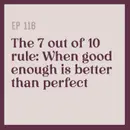
As I was out on a walk this morning, something I heard on Cal Newport's podcast resonated with me. I'm sharing a small takeaway point regarding over-optimizing and how I think that applies both to our clinical work and to everything that goes on behind the scenes to keep a clinical practice running.
Key Takeaways-
The optimization paradox: over-optimizing a single area can throw the whole system out of balance
-
In client work, you don't need to move every health pillar from a 2 to a 10. Moving several from a 2 to a 5 or 7 often produces better outcomes.
-
In your practice, "good enough" marketing across multiple channels beats getting one area in tip-top shape.
-
This framework is especially useful for solo practitioners without formal business or marketing training as it takes some pressure off and offers multiple ways to improve
-
Cal Newport's Deep Questions podcast: Optimization Paradox episode with Brad Stulberg
-
Sign up for Camille's weekly Practitioner Notes newsletter at camillefreeman.com
-
Find all episodes and show notes at intheclinic.com
Camille Freeman, DCN, RH, is the founder of Bloom and Grow, offering continuing education and community resources for herbalists and nutritionists in clinical practice. She has been in practice since 2003 with a focus on fertility, pregnancy, and menstrual health.
Thanks for listening.
I'd love to hear from you. Leave me a voicemail with feedback or submit a question (click the pink "Send Camille a Message" button on the side of the page) 💚
Camille's Helpful Links for Practitioners
0:00 Hi there. Welcome to In the Clinic with Camille. My name is Camille Freeman. I am the owner of Bloom and Grow, where we offer continuing education and community resources for herbalists and nutritionists who are in clinical practice. I wanted to share some thoughts with you today that were sparked by a podcast I listened to when I was out on my walk with my dog Wade this morning. Most days I listen to a podcast when we are out and about doing our sniffing and walking and so forth. And this morning, I was listening to Cal Newport's Deep Questions podcast. If you're not familiar with this podcast, it is about the deep life, meaning how do you organize a life such that you are able to do deep work, but also to do other things that matter to you.
0:41 So we're trying to think about, you know, how do you carve out time to do the kind of work that matters, let go of things that don't matter, and, you know, have a good life. So I really appreciate what Cal has to say. I often try to listen to his episodes. And today he had an interview with somebody named Brad Stolberg, who I don't know anything about. It was an interesting interview. It was about what they called the optimization paradox, meaning it's possible to over-optimize. Like if you track and optimize everything down to the last drop, sometimes you're actually not getting the benefit of doing that, and it may actually make things worse. So overall, worth a listen. I think there's a lot of useful and interesting food for thought.
1:26 But the part that jumped out at me that I wanted to share with you and share some reflections about in this interview had to do with Brad, the person who was being interviewed on the podcast. He interviewed, this is like a complex web here, you don't have to worry about all the details, but he interviewed a trainer who works with elite athletes, like Olympic quality, world class, that sort of thing. And this trainer was talking about how when you're at that level of performance and you're trying to say, Optimize everything you can the night before or leading up to some major event, performance, whatever it is. That there are several things that matter. You know, sleep matters the night before, the week before.
2:10 What you eat matters. Your specific training regimen in the gym or in the field or whatever it is matters. Your mindset matters. You're, you know, all the different, there's all these different components that matter. And what this trainer was saying was that they're all related. There's a synergy between the different components. And if you just take one component and you slice it out and you say, okay, we're going to like completely optimize diet, you know, we're going to know every last calorie, we're going to figure out exactly which macros go where and blah, blah, blah. Blah, if you get that one thing super optimized and really focus in on it, the other things suffer. Not necessarily because they are going off the deep end, but because synergistically, if you pay way more attention to one than the others, it throws the balance off.
2:57 And so this trainer's philosophy was that what you want to do is take all the different areas that you think contribute to that person having a really solid performance and. And you want to get all of those different components to about a 7 out of 10. So you don't need to go every last step of the way. You don't need to go the full mile. But you do want to make sure that it's well above average for that person in general. And I thought, oh my gosh, I love this idea for a couple of reasons. One of the reasons is because I think the same could be true of our individual health. So when we're working with our clients, and we, of course, we all have some core pillar things that matter to us, they might be slightly different depending on your modality and your philosophy and whatever.
3:40 But for example, we all have things where like, okay, we would like for our clients to be sleeping well, we would like for them to be. Eating nutrient dense, diverse diet, we would like for them to be staying hydrated, we would like for them to be having some kind of stress management plan in place, we would like, etc. There's some different columns or categories that you might think of. I really love the idea that if you just fully focus in on just one, it may be to the detriment of the whole. And I also really appreciate the idea that none of them have to be perfect in order for all of them to work together and make something exceptionally good, great, in terms of something, I guess I should say someone, to lead that person to feeling better than they ever have, even if each individual thing is only, say, 7 out of 10 on average.
4:30 I feel like that takes a lot of pressure off of the person. I think we're all trying to be healthy in many ways as well, but also with us as practitioners, where we don't necessarily have to take somebody from, a 2 out of 10 all the way up to a 10 out of the 10 in every single category. We can just move the needle closer to a 5, closer to a 7, in a bunch of different ways. And collectively, that synergistically gets us way farther than only moving one thing all the way up the chart. So I think that's really great. And I love that idea. And I think I might use it when talking to clients, especially those who are getting really bogged down. For example, in, you know, my sleep has been terrible and this, Y, and Z.
5:13 It's like, oh, okay, well, you know, I think that putting things in perspective like this can be really helpful. However, I also thought, you know, I think the same concept applies to running our clinical practices, where if we take, say, marketing, we each probably have several pillars of things that happen in our marketing, where maybe it's for you showing up on social media or doing your newsletter or giving talks and presentations and. Reaching out to people and asking them for follow-up visits or asking them for referrals. There's all these different parts of our marketing that we probably have in play and i really appreciate the idea that we want to try to, get each of those up to something in the range of a seven without trying to stress out about all of them not being 10 out of 10 because i think it's so easy to be like oh my website, you know some of these links are broken and this one picture is old and it doesn't exactly say what i want it to say and all this and being like oh it's not perfect, but when you think about it through this lens where you're like well, you know just trying to get to 7 out of 10 in most areas.
6:16 And then all that together synergistically winds up making a huge difference. And I think that is so true in these components of our business. So I guess I wanted to just share this in case it helps take some of the pressure off of you in your clinical practice as well, to just be like, all right, 7 out of 10 is pretty good. You know, especially for those of us in solo practice where we don't have a lot of support, we're doing the best we can, often with no training in marketing or business or anything like that. I think aiming for moving towards a 7 out of 10 in most of these categories where you're like, okay, I feel like I know what I need to do. I'm mostly doing it. I'm doing it pretty well. Maybe not absolutely to the 100% best of my abilities every single time, but I'm doing it.
7:00 And I think that if you do that pretty consistently, if you get hover in that 7 out of 10 average range, maybe some are a little lower, some might be really great and a little higher, I think you would be surprised at how far you can come with that. So anyway, that's my little thought for today. I hope you're having an amazing day. If you would like to stay in touch, the best way to do that is to sign up for my weekly practitioner notes newsletter. I send that out every Thursday. It covers something totally different than what's here in the podcast. So if you want to get the full scope of what I'm talking about and thinking about, sign up for that Practitioner Notes newsletter. It's just a short note to you. I share three resources, things that have been helpful, useful, interesting, delicious, what have you, every single week.
7:46 And then I will also let you know if I have any upcoming events, programs, things like that, that might be of interest. If you want to sign up for that, there is a link in the show notes, or you can just go to camillefreeman.com or intheclinic.com, which is my podcast website. All right, I will be back next week. Until then, take care and thank you so much for the work that you do.


